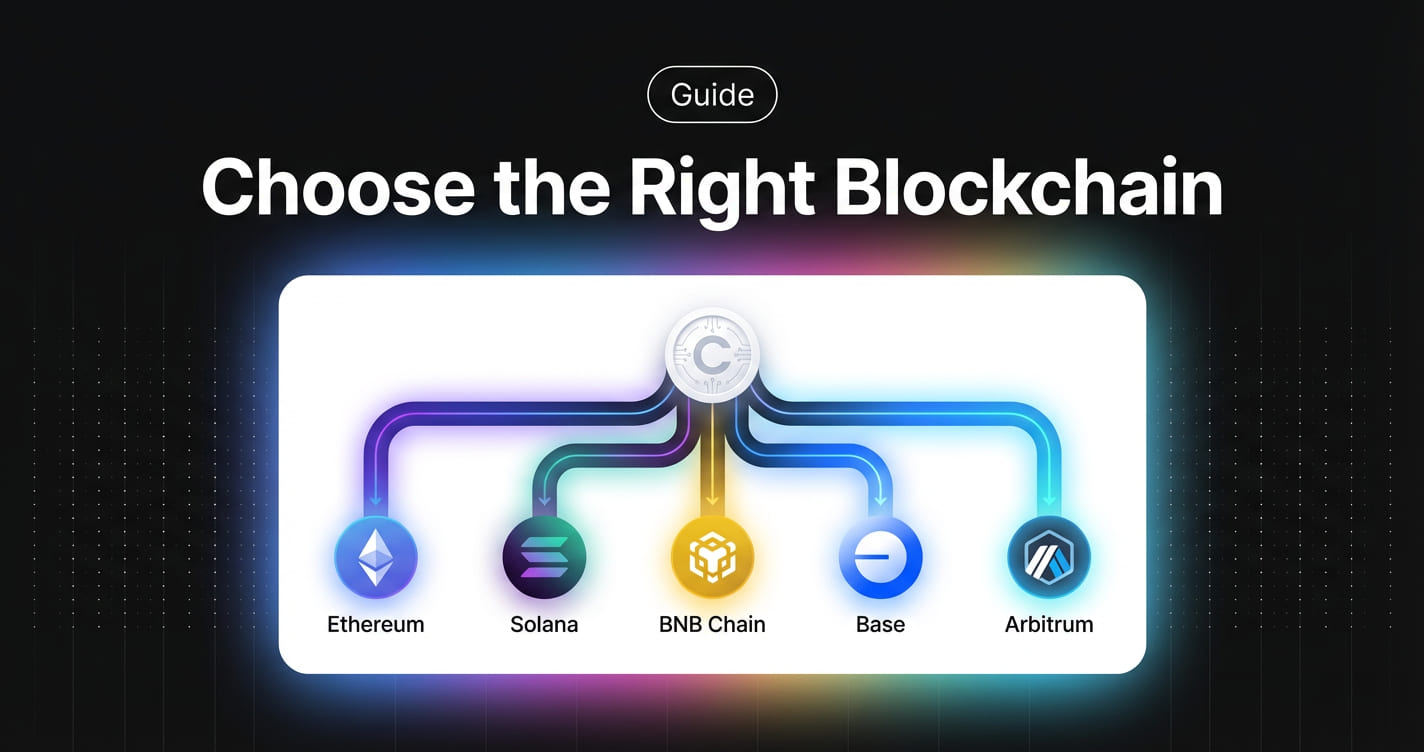
You can deploy a token on Ethereum, Base, Solana, BNB Smart Chain, Arbitrum, Optimism, Polygon, among others. They all handle fees, speed, and security differently, and each one attracts a different crowd. What makes sense for your project really comes down to what you're building and who it's for.
Here's a rundown of the most popular chains for token creation so you can pick the one that fits your project.
What to consider when choosing a blockchain
Before you compare specific chains, think about these four factors:
Gas fees
Every token deployment and transaction costs gas. On Ethereum mainnet, deploying a contract can cost $20-100+ depending on network activity. On L2s like Base or Arbitrum, the same deployment might cost under $1. If you're launching a community token or meme coin where people are trading small amounts, high gas fees will kill your momentum.
Ecosystem and DEX support
Your token needs liquidity and trading infrastructure. Check which DEXs are active on a chain (Uniswap, PancakeSwap, Raydium, etc.), what analytics tools exist (DexScreener, DexTools), and whether there are active DeFi protocols your token could plug into. A token on a chain with no liquidity venues is basically stranded.
Your target audience
Where do your users already live? If your community is on Telegram trading meme coins, they're probably on Base or Solana. If you're targeting DeFi power users, they might be on Arbitrum. If you're building for the Asian market, BNB Smart Chain has a massive user base there. Go where your people are.
Security and decentralization
Ethereum mainnet has 400,000+ validators and years of battle-tested security. L2s like Base and Arbitrum inherit much of Ethereum's security but add some trust assumptions around sequencers. Solana uses a completely different consensus model. For high-value projects where trust matters most, the security profile of your chain matters.
Chain-by-chain breakdown
Ethereum
The original smart contract platform and still the most credible chain to launch on. With 400,000+ validators, Ethereum has the strongest security and decentralization of any chain. The trade-off is cost: gas fees are significantly higher than L2s or alternative L1s. For serious projects that need maximum trust, nothing else really competes. Deploy with our Ethereum Token Creator.
Base
Base is an L2 built on the OP Stack with very low fees and a fast-growing ecosystem. The Coinbase backing gives it brand recognition that other L2s don't have, which helps with onboarding less crypto-native users. It's become the go-to chain for meme coins, community tokens, and new projects that want cheap deployment without sacrificing Ethereum security.
Launch your token with the Base Token Creator.
BNB Smart Chain
Low fees, one of the largest user bases in crypto (especially in Asia), and PancakeSwap as the dominant DEX. The DeFi ecosystem is well-established. It's not EVM-identical — there are some differences in tooling — but it's close enough that most Solidity contracts work without changes. Get started with the BNB Smart Chain Token Creator.
Solana
Completely different architecture from EVM chains. Tokens are SPL tokens, not ERC-20s, and the tooling is separate. What you get in return is extremely fast transactions and very low fees. Solana also has one of the most active trading communities in crypto right now. Create your token with the Solana Token Creator.
Arbitrum
Arbitrum is an L2 where DeFi really thrives. Uniswap V3, GMX, and other major protocols are all active there, which means your token has immediate access to deep liquidity. Fees are low and the developer tooling is solid. If your token is DeFi-focused, Arbitrum is worth a close look.
Try the Arbitrum Token Creator.
Optimism
Optimism is part of the Superchain, a network of interoperable L2s built on the OP Stack. That means tokens deployed on Optimism are positioned for native cross-chain reach as the Superchain ecosystem grows. If interoperability is part of your roadmap, Optimism gives you a head start. Deploy with the Optimism Token Creator.
Polygon
Polygon offers very low fees and has carved out a niche around gaming and utility tokens. If your project involves NFTs, in-game currencies, or other utility-focused use cases, Polygon's user base and tooling fit well. It's also one of the more accessible chains for developers new to web3.
Comparison table
| Chain | Deploy Cost | Speed | Ecosystem | Main DEX | Best For |
|---|---|---|---|---|---|
| Ethereum | $20-100+ | ~12s blocks | Largest | Uniswap | Serious, high-trust projects |
| Base | Under $1 | ~2s | Fast-growing | Uniswap, Aerodrome | Meme coins, community tokens |
| BNB Smart Chain | $1-5 | ~3s | Large | PancakeSwap | DeFi tokens, Asian market |
| Solana | Under $1 | ~400ms | Large | Raydium, Jupiter | High-throughput, SPL tokens |
| Arbitrum | Under $1 | ~250ms | Strong DeFi | Uniswap V3, Camelot | DeFi-focused tokens |
| Optimism | Under $1 | ~2s | Growing | Velodrome | Cross-chain, Superchain projects |
| Polygon | Under $0.10 | ~2s | Large | QuickSwap | Gaming, utility tokens |
Quick decision guide
Not sure which chain fits your project? Use these shortcuts:
- You want the cheapest deployment -> Base, Solana, or Polygon. All three let you deploy for well under $1.
- You want maximum trust and credibility -> Ethereum. 400k+ validators and years of track record speak for themselves.
- Meme coin or community token? Base. Low fees, active community, and Coinbase brand recognition pulling in new users.
- You need cross-chain interoperability -> Optimism and the Superchain. Built for chains to talk to each other.
- Targeting DeFi users -> Arbitrum. Deep liquidity and Uniswap V3 out of the box.
- Your audience is in Asia -> BNB Smart Chain. Massive user base and PancakeSwap ecosystem.
- You want non-EVM architecture -> Solana. Different tech stack, but extremely fast and cheap.
- Gaming or utility token -> Polygon. Near-zero fees and a large ecosystem already built around these use cases.
Deploy on any of these chains
You don't need to write code to create a token on any of these blockchains. Our Token Builder lets you configure and deploy ERC-20 tokens in minutes. Pick your chain, set your token parameters, and deploy straight from your browser.
- Create a token on Ethereum
- Create a token on Base
- Create a token on BNB Smart Chain
- Create a token on Solana
- Create a token on Arbitrum
- Create a token on Optimism
FAQ
Which blockchain is the cheapest for creating a token?
Base, Solana, and Polygon all come in well under $1. For EVM-compatible chains specifically, Base and Polygon are your cheapest bets. Solana is in the same ballpark price-wise but uses SPL tokens instead of ERC-20. Any of the three will work if cost is your main concern.
Is Ethereum still worth it for launching a token?
Yes, if your project needs maximum credibility and security. Ethereum has the largest validator set and the deepest liquidity — nothing else comes close on those fronts. Gas fees are higher, that's the trade-off. But for serious projects where trust is non-negotiable, it's still the standard. You can also deploy on an Ethereum L2 like Base or Arbitrum to get low fees while still benefiting from Ethereum's security.
What is the difference between ERC-20 and SPL tokens?
ERC-20 is the token standard on Ethereum and all EVM-compatible chains (Base, Arbitrum, Optimism, BNB Smart Chain, Polygon). SPL is what Solana uses. They're not interchangeable — an ERC-20 token only works on EVM chains, and an SPL token only works on Solana. You don't really "choose" a standard; it's determined by which blockchain you deploy on.
Can I deploy the same token on multiple blockchains?
You can deploy separate token contracts on different chains, but they won't automatically be the same token. To have a token that works across multiple chains, you'd typically deploy on one chain and then use a bridge to create wrapped versions on other chains. The Superchain is working toward native interoperability that makes this easier, but for now, multi-chain tokens require bridging infrastructure.