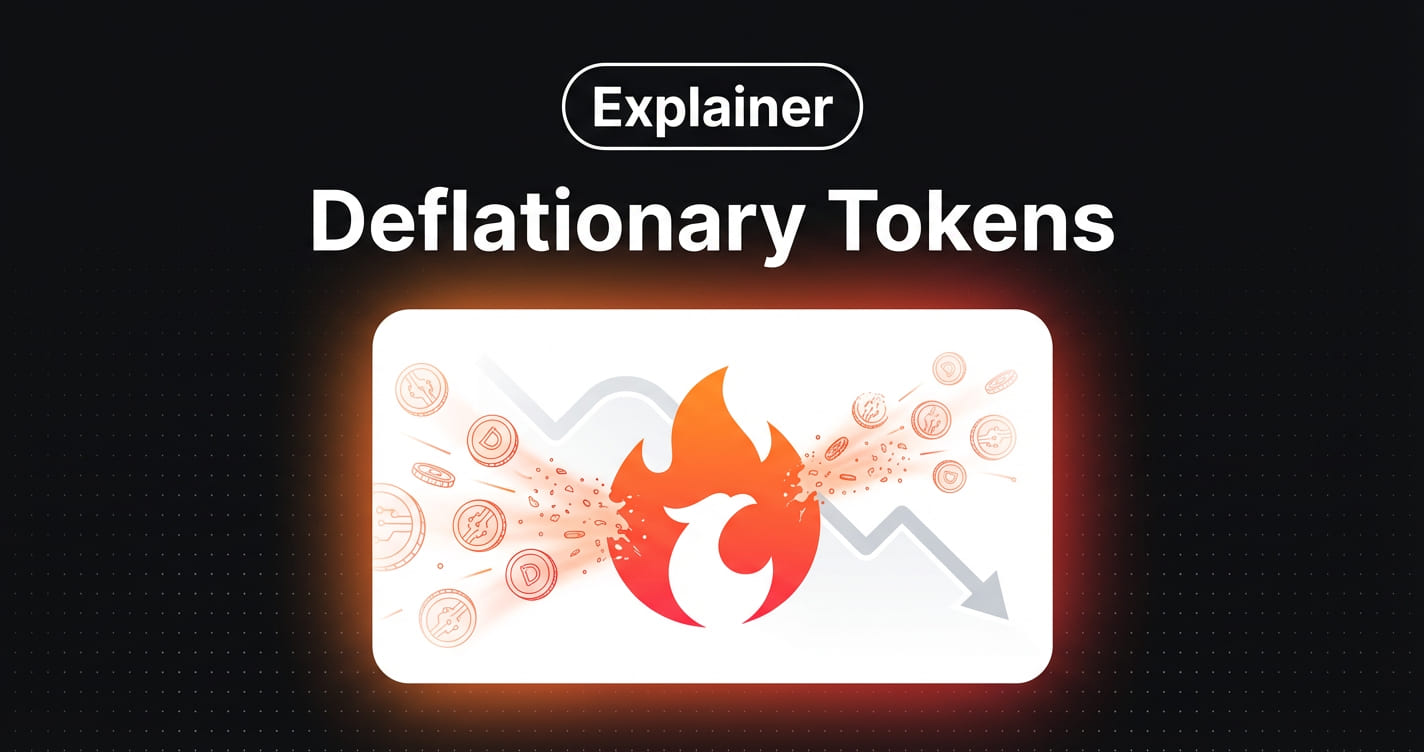
Most tokens have a fixed supply or even let the creator mint more over time. Deflationary tokens do the opposite. Every time someone buys, sells, or transfers, a small percentage of the transaction gets burned permanently. The total supply shrinks with every trade, making the remaining tokens scarcer.
What is a deflationary token?
A deflationary token is a cryptocurrency that automatically reduces its own circulating supply over time. It does this through a built-in burn tax: a percentage of every transaction gets sent to a dead address (usually 0x000...dead), removing those tokens from circulation forever. The more the token gets traded, the faster the supply shrinks. This creates programmatic scarcity without anyone needing to manually burn tokens.
Unlike standard ERC-20 tokens where the supply stays constant, deflationary tokens are designed to become rarer over time. If demand stays the same but supply keeps dropping, each token becomes more valuable.
How does a burn tax work?
The burn tax is what makes every deflationary token work. Here's what happens when someone makes a trade:
- A transfer is initiated. Someone sends, swaps, or trades tokens
- The contract calculates the tax. If the burn tax is 2%, and you're sending 1,000 tokens, the contract takes 20 tokens as the fee
- Those 20 tokens get sent to
0x000...dEaD, a dead address that nobody controls. They're gone forever - The recipient gets the rest. The other 980 tokens arrive in the destination wallet
You can configure the burn percentage to be whatever makes sense for your project. A 1-2% burn is common for tokens that want steady, long-term deflation. Higher percentages like 5% create faster scarcity but also mean traders lose more per transaction.
Some deflationary tokens also split the tax between burning and other purposes, like sending a percentage to a marketing wallet or redistributing to holders. With our Deflationary Token Creator, you can set separate buy and sell tax percentages so you have full control over how aggressive the deflation is on each side.
Anti-whale features
A deflationary token without anti-whale protections is asking for trouble. One large wallet can accumulate a massive chunk of the supply and dump it all at once, crashing the price for everyone else. That's why most serious deflationary tokens include wallet and transaction limits.
Max wallet limit sets a cap on how many tokens any single wallet can hold. If the limit is 2% of total supply, nobody can accumulate more than that. This prevents any one holder from having too much control over the price.
Max transaction limit caps how many tokens can be moved in a single transfer. Even if someone holds close to the max wallet amount, they can't dump it all in one trade. They'd have to spread it across multiple transactions, giving the market time to absorb the selling pressure.
Together, these two features level things out. They don't guarantee price stability, but they make rug-pull-style dumps a lot harder to pull off.
Why create a deflationary token?
Deflationary mechanics work well for a few specific use cases:
- Community tokens get a built-in reason for holders to stay rather than flip. The longer they wait, the scarcer the supply gets
- Meme coins with built-in scarcity: Instead of relying purely on hype, the token has a real mechanical reason to become more valuable over time
- Reward-based ecosystems pair the burn with holder redistribution so active community members benefit from trading volume
- Anti-dump projects: Wallet and transaction limits combined with burn taxes discourage large-scale selling
If your project needs a token that rewards patience and punishes quick flips, deflationary mechanics are worth a look.
How to create a deflationary token
You can deploy a deflationary ERC-20 token in minutes using our Token Builder. No coding required. Here's how:
Step 1: Connect your wallet and pick a chain
Head to the Deflationary Token Creator and connect your wallet (MetaMask or any EVM-compatible wallet). Pick the chain you want to deploy on, we support Ethereum, Base, BNB Smart Chain, Arbitrum, Polygon, and more.
Step 2: Enter your token details
Fill in the basics: token name, symbol, and total supply. These are permanent once deployed, so double-check everything.
Step 3: Enable deflationary features
Turn on the burn tax and set your buy and sell tax percentages. You can also enable max wallet limits and max transaction limits to add anti-whale protection.
Step 4: Set your fee percentages
Decide how much of each transaction gets burned. A 1-2% burn tax is a safe starting point. You can also split taxes between burning and a marketing or development wallet if your project needs ongoing funding.
Step 5: Deploy
Review your configuration, hit deploy, and confirm the transaction in your wallet. Your deflationary token will be live on-chain within seconds. You'll get a contract address you can share with your community and list on DEXs.
Want even more control? Our Ultimate Token includes everything in the deflationary template plus additional features like minting, pausing, and more granular fee distribution.
Deflationary vs standard tokens
| Feature | Standard token | Deflationary token |
|---|---|---|
| Supply over time | Stays the same | Decreases with every trade |
| Burn mechanism | None (unless manual) | Automatic on every transaction |
| Anti-whale limits | Not built in | Max wallet and max transaction caps |
| Buy/sell taxes | None | Configurable percentages |
| Holder incentive | None by default | Scarcity increases over time |
| Complexity | Simple | Slightly more complex |
Standard tokens are great for straightforward utility. Deflationary tokens are better when you want built-in scarcity and trading incentives baked into the contract.
Frequently asked questions
What happens when all tokens are burned?
In practice, this won't happen. As the supply shrinks, each token becomes more valuable, and the absolute number of tokens burned per transaction gets smaller and smaller. If only 100 tokens remain and someone sends 10 with a 2% burn, only 0.2 tokens get burned. The supply approaches zero but never actually reaches it. Some projects also exempt certain wallets (like the liquidity pool) from the burn tax to keep trading functional.
Can I change the burn tax after deployment?
It depends on how the token is configured. With CreateMyToken's Deflationary Token Creator, you can set the contract so the owner can adjust tax percentages after deployment. This gives you flexibility to respond to market conditions or community feedback. Check the token settings before you deploy to make sure owner controls are configured the way you want.
Which chains support deflationary tokens?
You can deploy deflationary tokens on any EVM-compatible chain. Through our Token Builder, that includes Ethereum, Base, BNB Smart Chain, Arbitrum, Optimism, Polygon, Avalanche, and more. The burn tax and anti-whale mechanics work the same way regardless of which chain you pick.
How is a deflationary token different from a fair launch token?
A fair launch token focuses on distribution: 100% of supply goes into a liquidity pool with no pre-sale or team allocation. A deflationary token focuses on supply mechanics: the total supply shrinks over time through burn taxes. They solve different problems, but you could potentially combine elements of both depending on your project goals.
Useful links
- Deflationary Token Creator: Create Deflationary Token
- Ultimate Token Builder: Ultimate Token
- Token Builder Overview: Token Builder
- Fair Launch: Fair Launch
- FAQ: Frequently Asked Questions