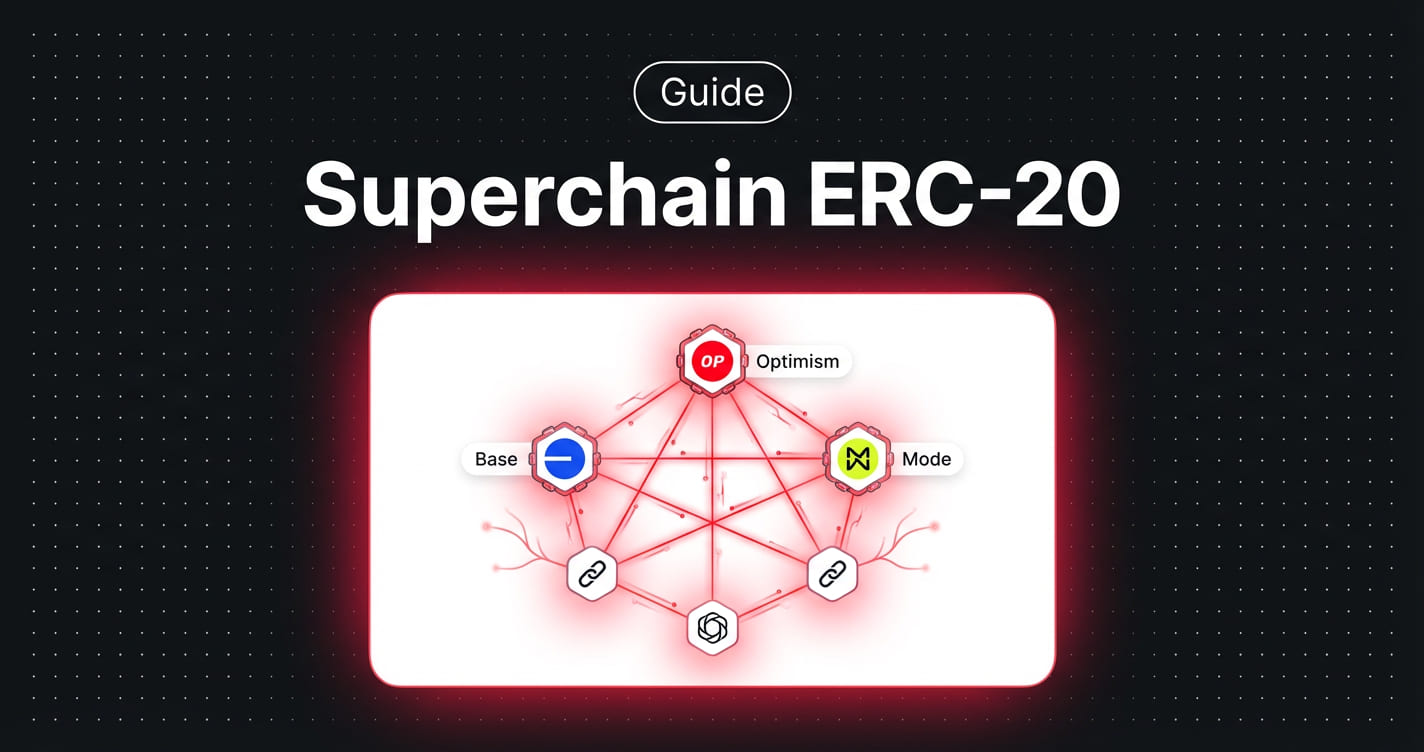
The Optimism Superchain is changing how tokens work across chains. Instead of deploying separate contracts on Base, Optimism, Mode, and every other OP Stack chain, you can now deploy a single Superchain ERC-20 token that works across all of them. One token, one supply, many chains.
If you've been wondering how to deploy a token across OP Stack chains without dealing with bridges or wrapped assets, this is it.
What is the Superchain?
The Superchain is a network of blockchains built on the OP Stack, Optimism's open-source rollup framework. Chains like Base, Optimism Mainnet, Mode, Ink, World Chain, Soneium, Unichain, and Fraxtal all share the same underlying architecture, which means they can communicate with each other at the protocol level.
Rather than a collection of isolated blockchains that need bridges to talk to each other, the Superchain connects them into one unified network. Assets and messages can move between chains without relying on third-party bridge protocols, which matters if you're creating tokens.
You can explore the full ecosystem on our Superchain overview page.
What is a Superchain ERC-20?
A Superchain ERC-20 is a cross-chain token standard designed specifically for the Optimism Superchain. It extends the regular ERC-20 standard with built-in cross-chain functionality, so your token can move freely between any chain in the Superchain without needing bridges, wrapped versions, or custom contracts on each network.
How it differs from a regular ERC-20:
- Native cross-chain transfers: Tokens move between Superchain networks through the protocol itself, not through third-party bridges
- Single supply: There's one unified token supply across all chains, no fragmented liquidity or confusing wrapped versions
- Consistent contract address: Your token has the same address on every Superchain network, making it easy for users and integrators
- Standardized interface: Built on top of ERC-20 with additional methods for cross-chain minting and burning
When a user sends tokens from one Superchain network to another, the tokens are burned on the source chain and minted on the destination chain. This happens at the protocol level, so there's no counterparty risk and no bridge fees beyond standard gas costs.
Which chains are part of the Superchain?
The Superchain keeps growing, but here are the major chains currently in the network:
- Base: Coinbase's L2 and one of the most active chains in the ecosystem, with strong DeFi and consumer app traction
- Optimism Mainnet: The original OP Stack chain. Home to the Optimism Collective and a deep DeFi ecosystem.
- Mode: DeFi and yield optimization, with incentives for builders and users
- Ink: Kraken's L2, built for DeFi with low fees and fast finality
- World Chain: From the Worldcoin team, focused on identity-verified human transactions
- Soneium: Sony's L2. Targets entertainment, gaming, and creative applications.
- Unichain: Uniswap's own L2, optimized for DeFi trading with faster block times
- Fraxtal: Frax Finance's chain for stablecoins and DeFi infrastructure
By deploying a Superchain ERC-20, your token gets access to all of these ecosystems immediately.
Why deploy a Superchain ERC-20?
If you're building a token that needs to work across multiple chains, the Superchain ERC-20 standard has clear advantages:
- One deploy, many chains: Deploy once through the Superchain ERC-20 Launcher and your token is available across every Superchain network. No need to manage separate contracts or coordinate multi-chain deployments.
- Combined liquidity: Instead of splitting your token's liquidity across isolated chains, Superchain ERC-20 keeps everything unified. Users on Base, Optimism, Mode, and other chains all share the same token supply.
- No bridge risk: Traditional bridged tokens rely on third-party protocols that can be exploited. Superchain ERC-20 uses native protocol-level transfers, so there's no bridge contract to hack.
- Future-proof: As new chains join the Superchain, your token automatically works on them. You don't need to do anything extra.
- Better user experience: Your holders can move tokens between chains in seconds without hunting for bridge UIs or paying bridge fees.
For comparison, if you only need a standard ERC-20 on a single chain, our Token Builder handles that. But if cross-chain reach matters for your project, Superchain ERC-20 is the way to go.
How to deploy a Superchain ERC-20
Here's how to get your cross-chain token live.
Step 1: Open the Superchain ERC-20 Launcher
Go to the Superchain ERC-20 Launcher. This is our dedicated tool for deploying tokens across the entire Superchain network.
Step 2: Connect your wallet and enter token details
After connecting your wallet, fill in the basics: token name, symbol, and decimals. These details will be the same on every Superchain network where your token is deployed, and they're permanent once deployed, so pick a clear and memorable name and ticker.
Step 3: Configure your supply
Set your total token supply — this is the unified supply that exists across all Superchain networks. It determines your initial per-token price when you add liquidity later, so plan accordingly.
Step 4: Deploy
Confirm the transaction in your wallet and the launcher handles the rest. Once confirmed, your Superchain ERC-20 token is live and ready for cross-chain transfers.
You can check on your deployment and manage your token through the Superchain Hub.
Superchain ERC-20 vs regular ERC-20
| Feature | Regular ERC-20 | Superchain ERC-20 |
|---|---|---|
| Works on | Single chain | All Superchain networks |
| Cross-chain transfers | Requires bridges | Native protocol-level |
| Token supply | Per-chain | Unified across chains |
| Contract address | Different per chain | Same on all chains |
| Bridge risk | Yes | No |
| Best for | Single-chain projects | Multi-chain projects |
Need a regular ERC-20 on Base specifically? Our Base Token Creator is built for that. For multi-chain reach, go with Superchain ERC-20.
FAQ
Is a Superchain ERC-20 compatible with regular ERC-20 tools?
Yes. A Superchain ERC-20 is fully ERC-20 compatible. It works with MetaMask, Uniswap, block explorers, and any other tool that supports standard ERC-20 tokens. The cross-chain functionality is an extension on top of the base standard, so nothing breaks.
Do I need to deploy separately on each Superchain network?
No. That's the whole point of the Superchain ERC-20 standard. You deploy once through the Superchain ERC-20 Launcher, and your token is available across all supported Superchain networks. No multi-chain deployment scripts or manual contract verification needed.
How much does it cost to deploy a Superchain ERC-20?
The deployment cost is a single gas fee on the chain you deploy from. Since all Superchain networks are L2 rollups, gas fees are very low, typically under a few dollars. Cross-chain transfers after deployment only cost standard gas on the source chain.